The photo shows a Pokémon Platinum GTS screen. It points to an old exchange protocol, but the real messages are hidden in bytes the game ignores after a nickname ends. The solve crosses Generation 4 and 5 records, trades a valid Buizel, and assembles a flag from three returned Pokémon.
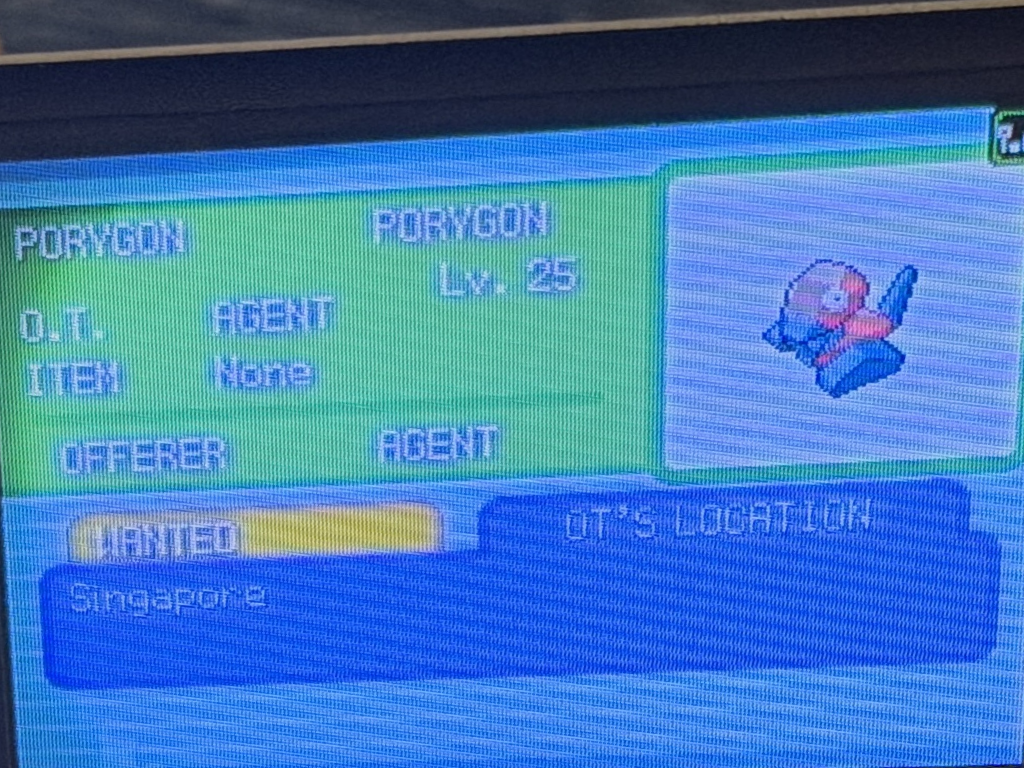
Speak GTS
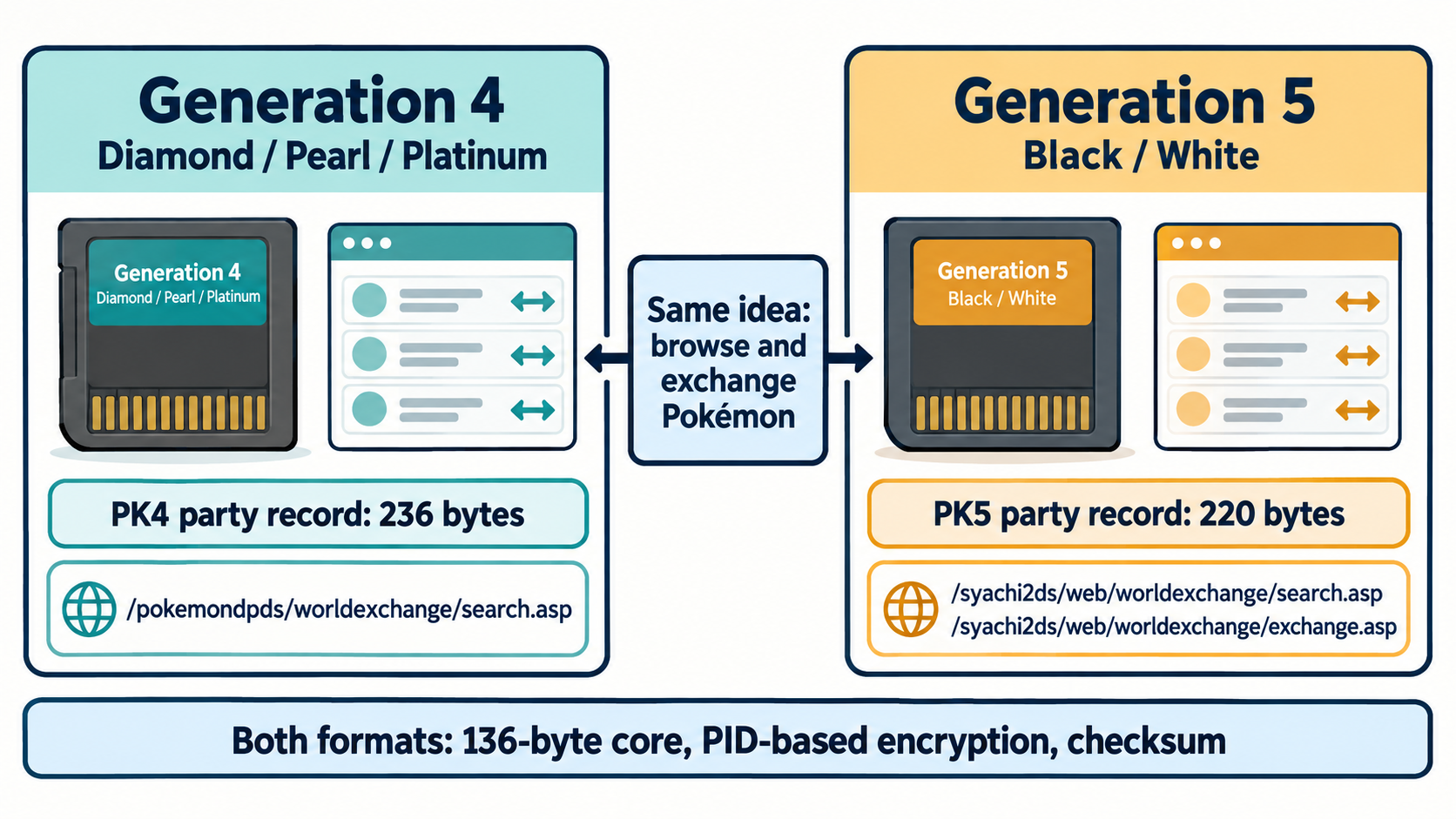
The challenge service at chals.tisc26.ctf.sg:31259 expects the legacy host gamestats2.gs.nintendowifi.net. Its useful routes are the Gen-4 .../pokemondpds/worldexchange/search.asp and Gen-5 .../syachi2ds/web/worldexchange/{search,exchange}.asp endpoints.
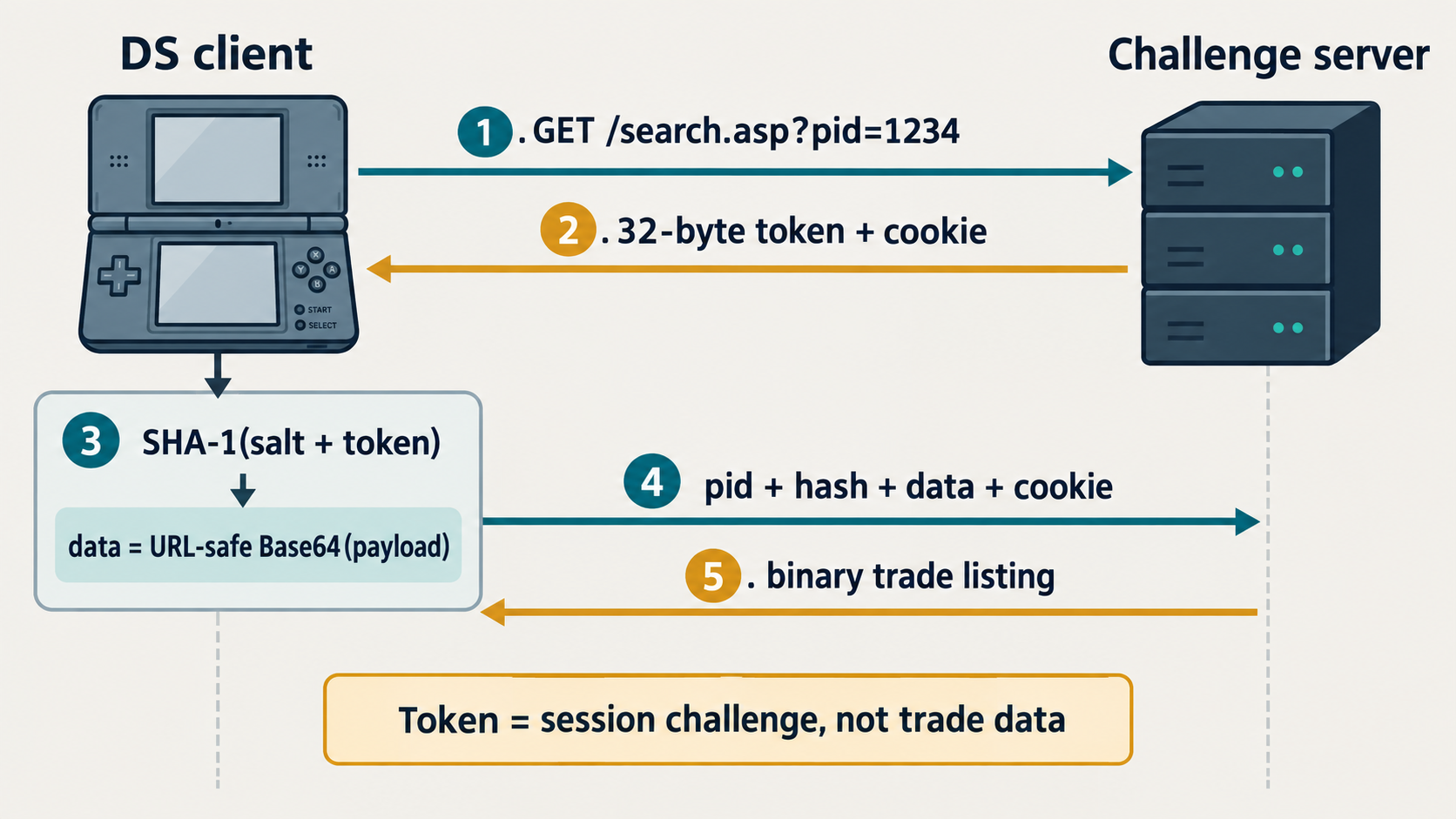
Each action starts with endpoint?pid=<client id>. The reply supplies a 32-byte token and session cookie; the second request sends the cookie, Base64 action data, and SHA1(game_salt || token). The salts and message format are public, so this is framing rather than strong authentication.
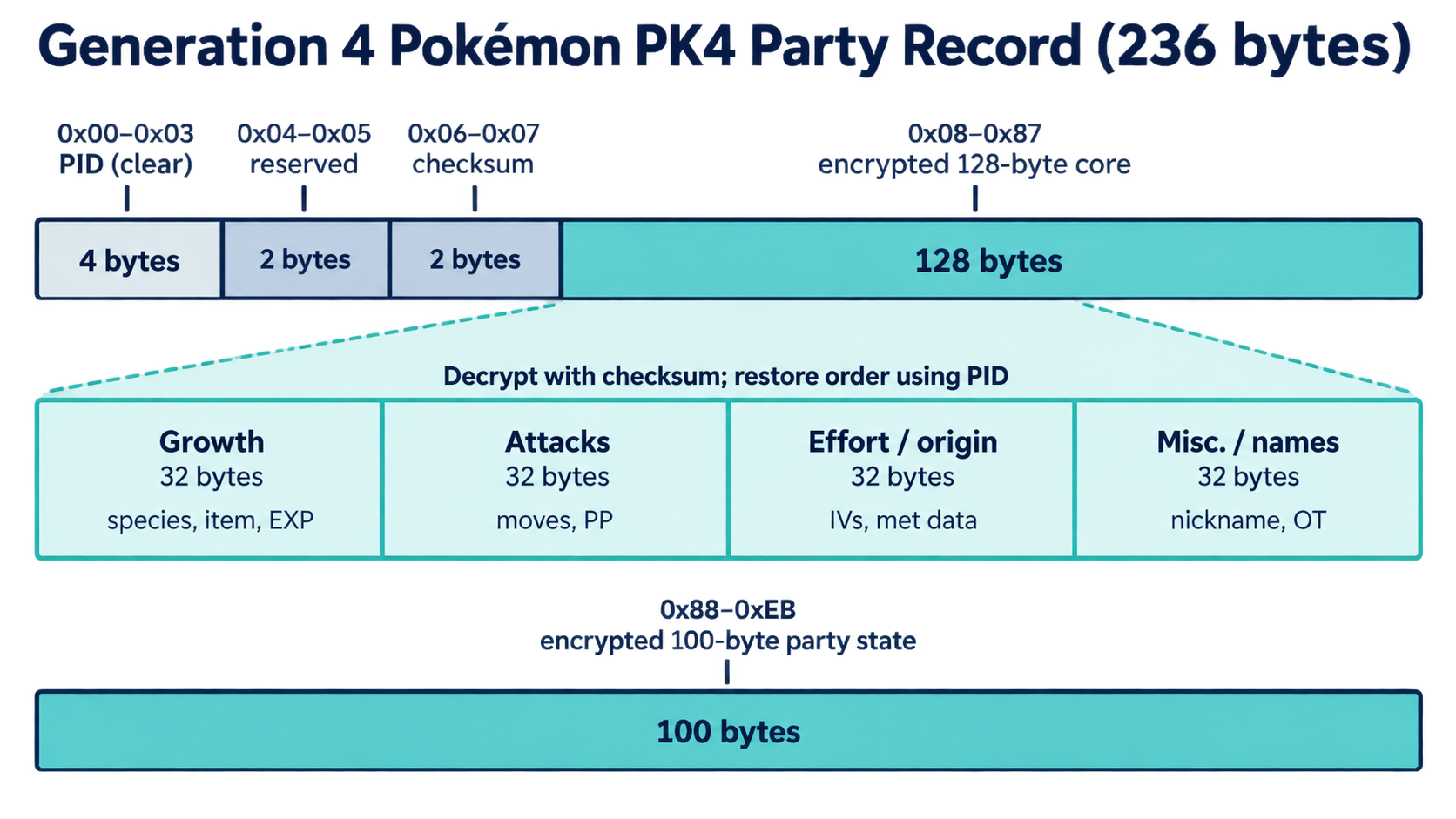
Results are binary Pokémon records. A Gen-4 listing embeds a 236-byte PK4 party record; Gen 5 uses a 220-byte PK5 inside a 296-byte GTS wrapper. Pokémon PID, checksum, block permutation, and encryption all matter. The HTTP pid, Pokémon PID, and listing ID are different values.
Follow the exchange chain
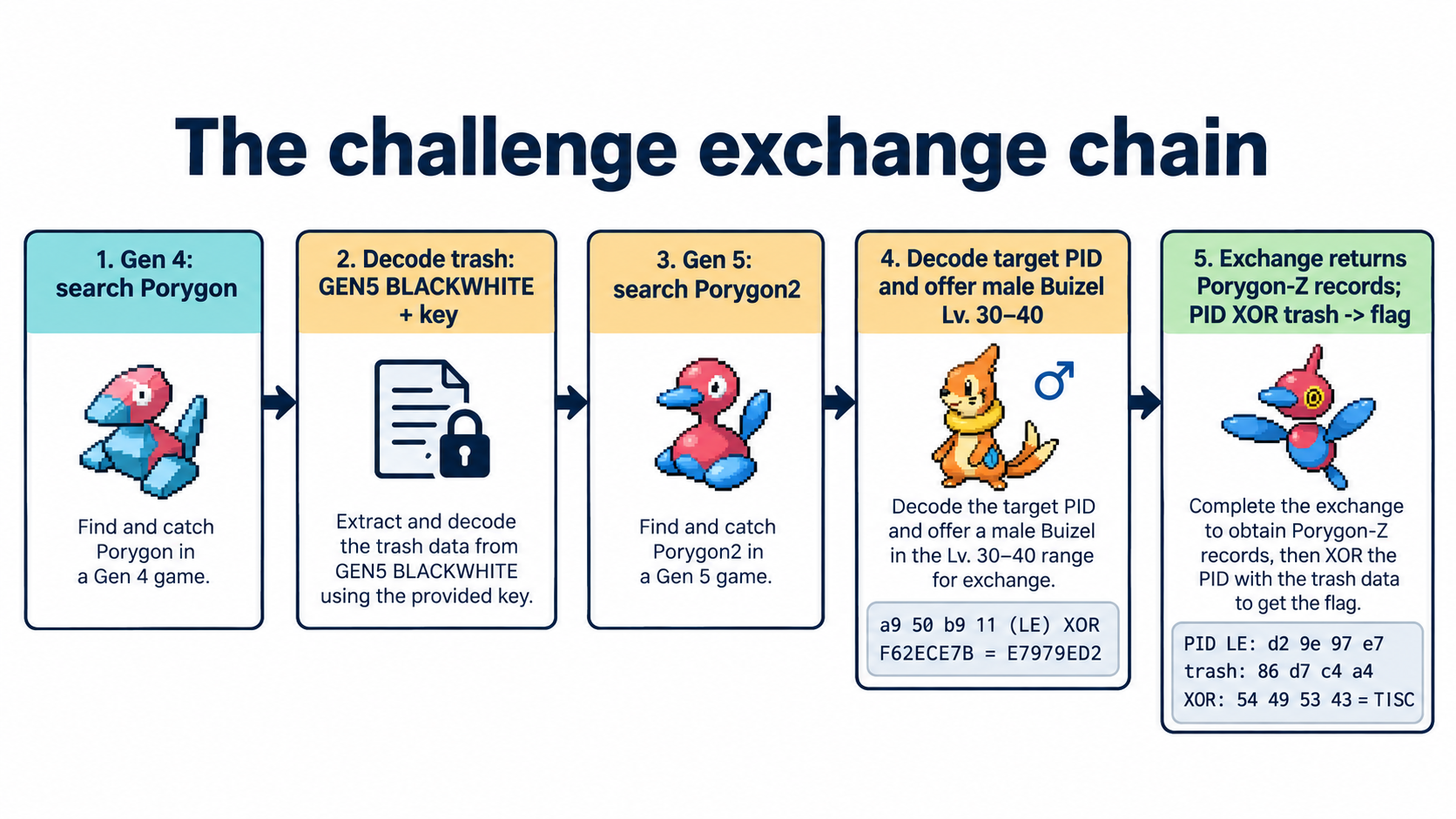
1. Search Gen 4 for Porygon (species 137). One response holds at most seven listings, while the challenge has ten. Repeat the search and deduplicate by the listing ID at offset 0x108. Decrypt the embedded PK4 records and look past the nickname's ff ff terminator. The ignored bytes spell:
G3N5_BL4CKWH1T3;P0RYG0N2_TR4SH=P1D_L3_X0R_K;K=<live key>
K changes between sessions, so the script reads it from the current listings.
2. Search Gen 5 for Porygon2 (species 233). The five outer listings include two impostors: their decrypted inner records are Ditto nicknamed NOT ME!. The other three have OT strings that combine into 0FF3R_M | BU1Z3L | Lv30-40: offer a male Buizel at level 30–40.
Their nickname trash encodes three hidden target PIDs. Interpret each four-byte value as a little-endian integer, then XOR it with K. In one captured session, 0x11b950a9 XOR 0xf62ece7b = 0xe7979ed2. The targets are e7979ed2, b618a9cf, and ddfc445a.
3. Make the trades. Build a valid Gen-5 male Buizel at level 30, perform an ordinary Porygon2 search to establish state, then send a 432-byte exchange.asp request:
0x000..0x127  296-byte offered Buizel record
0x128..0x12b  hidden target PID, little-endian
0x12c..0x1af  132-byte validation area (zeroes work here)
Each hidden target returns a 296-byte Porygon-Z record. No finish request is needed; the flag is already in those records.
4. Decode the answer. XOR the 16 nickname-trash bytes of each returned record with its Pokémon PID repeated as four little-endian bytes:
pid_le = struct.pack('<I', returned_pid)
chunk = bytes(b ^ pid_le[i % 4] for i, b in enumerate(trash))
The three chunks are TISC{p0lyg0n4l_p, 1d_ch41n_4cr0ss_, and g3ns}. Together:
TISC{p0lyg0n4l_p1d_ch41n_4cr0ss_g3ns}
Reproduce it
python3 solve.py performs the handshake, record decryption, searches, exchanges, and final XOR. The three decisive exchange responses are included as hidden-target-*.bin downloads.
For the real protocol and record formats, see Project Pokémon's Wi-Fi protocol notes, Gen-5 GTS research, PK5 structure, and the PKHeX PK4 implementation. The challenge-specific records and behavior came from the challenge service.
Resources & downloads
Selected files referenced by or useful for reproducing this solve.