The service guards a flag helper behind a one-time 16-character challenge. We could not read the helper, so the plan was to make the Omnitrix service run our code, talk to the helper, and carry its answer back through the service's own reply format.
Find the moving parts
omnitrix speaks a binary TCP protocol. Its 16-byte header starts with OMNI, then version, class, opcode, request ID, and body size; multi-byte fields are big-endian. Request IDs matter because background jobs reply out of order. The useful opcodes cover login (0x0010), lease creation/revocation (0x0020/0x0021), transforms (0x0041), mode changes (0x0050), diagnostics (0x0051), and replay (0x0053).
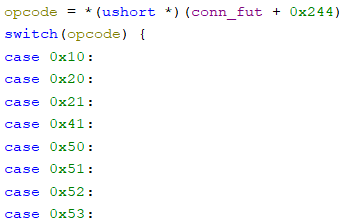
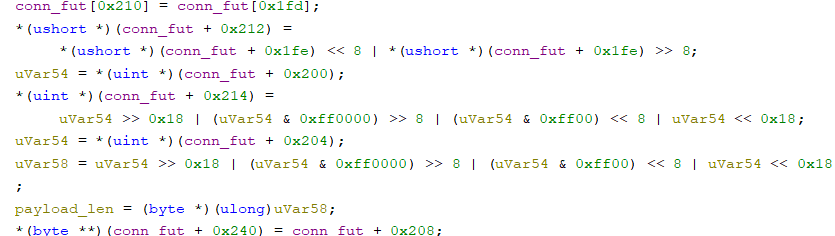
The challenge analysis reveals login ben.tennyson / its-hero-time:

A lease is a 16-byte temporary permission ticket. matrix.configure changes mode, dna.shift handles transform/upload jobs, and omnitrix.scan handles replay. Harmless probes showed that upload and replay need policy bits 0x150, absent from ordinary mode 2.
Race the permission snapshots
The mode-change worker combines facts captured at different times. It grants the stronger policy when the queued request was valid, at least 64 jobs remain outstanding, the lease epoch has changed, and the old lease still appears valid in a cache. That contradictory last pair is the bug. All four conditions set mask 0xf, changing mode-2 policy from 0x2a4 to 0x3f4 and enabling the missing 0x150 bits.
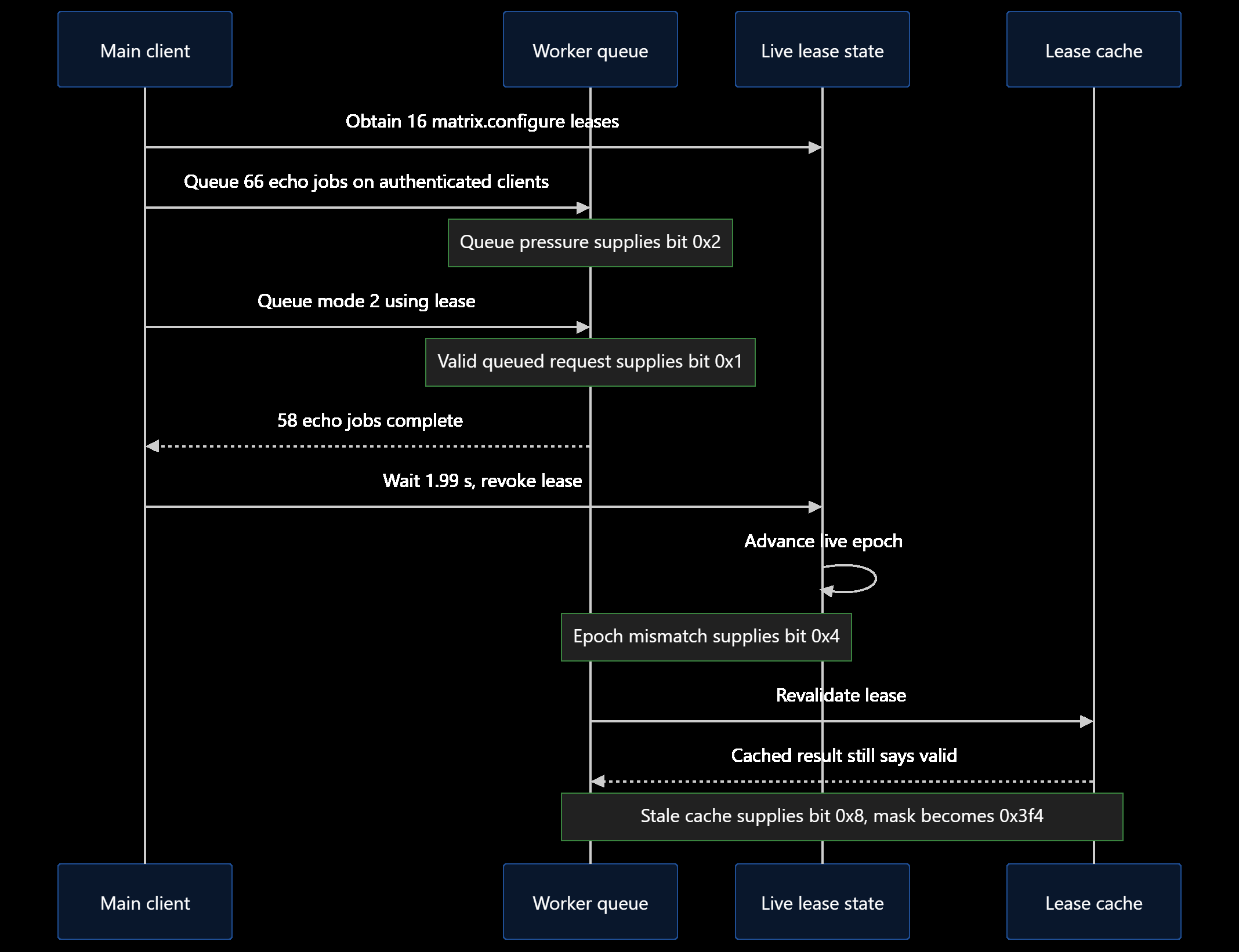
The reliable timing sequence was:
- Acquire 16
matrix.configureleases, plus onedna.shiftand oneomnitrix.scanlease. - Open 66 authenticated clients and queue an
echotransform from each. - Queue a mode-2 request with the first matrix lease.
- After 58 blocker jobs finish, wait 1.99 seconds and revoke the last matrix lease, leaving the queued request's lease alone.
- Try a harmless upload and replay. A policy error means the timing missed; restart with fresh connections.
Counting completed jobs matters more than sleeping a fixed time from startup, because the window follows worker progress.
Turn upload into execution
With the raced policy, codon.stream.inject writes chosen files under /tmp/omnitrix/codon/. A replay file has this structure:
"OREP" || u16be(1) || lp(form) || lp(template) || u16be(entry_count)
       || repeated (lp(key) || lp(value))
First, an ordinary merge replay with payload = replay-ok confirms the upload and recall path. Then an engage replay names the uploaded probe.so. The engage path calls dlopen and invokes the library's omnitrix_probe symbol: a transform input has become native code.
The module filter looked for dangerous imports, strings, and code shapes. The library imported bland file operations, found libc from open at runtime, parsed its in-memory ELF symbol table, and resolved obfuscated names such as fork, execve, and waitpid only after loading.
The helper is execute-only. The probe enumerated executables at /, ran candidates with pipes, and recognized the helper by its initial 16 hexadecimal characters. It echoed that fresh token back, received the flag, and saved the output inside a normal OREP merge record at replay/result.orep. A final 0x0053 recall brought the answer back without disrupting the framed TCP protocol.
Reproduce it
Build the library, then run the solver against the authorized local connector:
gcc -shared -fPIC -O2 -fno-stack-protector \
  -U_FORTIFY_SOURCE -D_FORTIFY_SOURCE=0 \
  -Wl,--build-id=none -Wl,-soname,probe \
  -o exploit.so exploit.c
strip --strip-unneeded exploit.so

python3 solve.py 127.0.0.1 7878 \
  --binary ./omnitrix --matrix-burst 16 --race \
  --blockers 66 --race-revoke matrix-other \
  --revoke-after-successes 58 --revoke-delay 1.99 \
  --probe-so ./exploit.so --show-result
The expected milestones include blockers_echo_result=58 and callback_result_received=True. The recovered flag was:
TISC{6r33n_n33dl3_0r_br41n5t0rm??}
Resources & downloads
Selected files referenced by or useful for reproducing this solve.