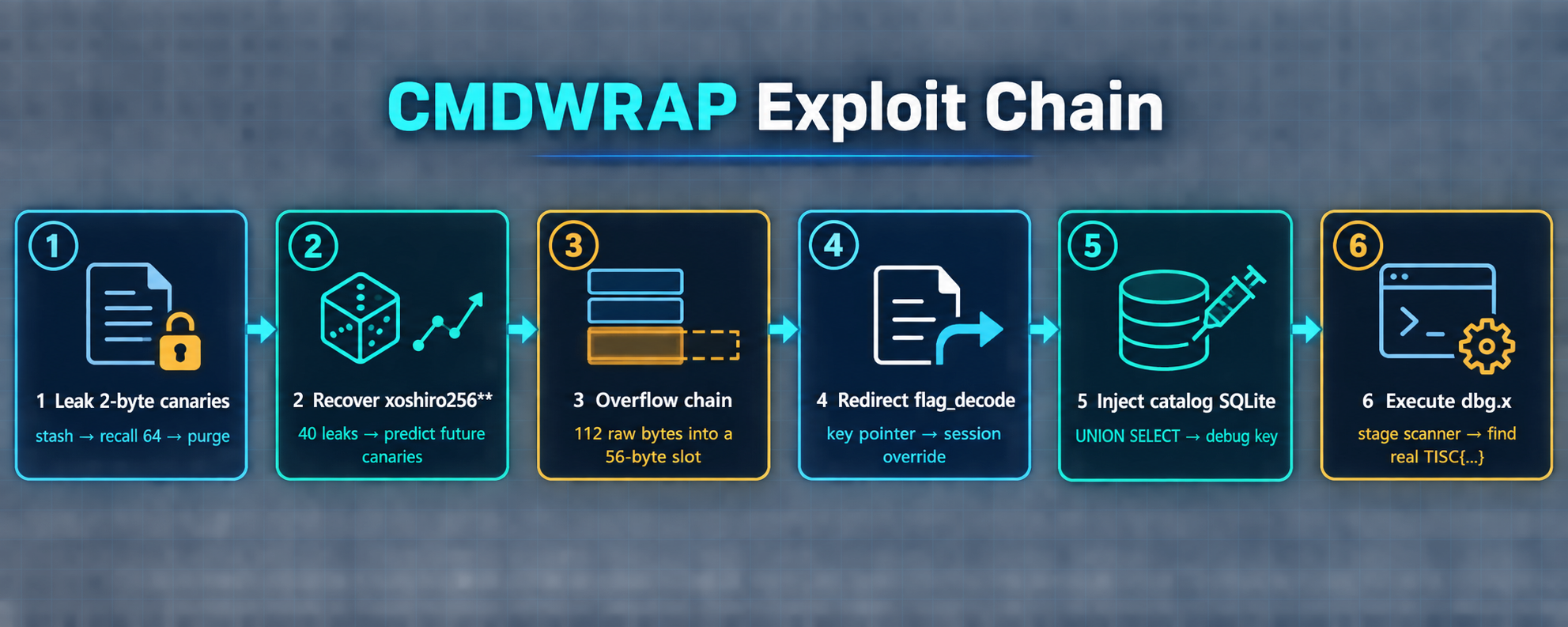
The service offers a tiny command shell whose powers arrive as downloadable DLL “capabilities.” One capability leaks an arena canary; another copies twice as many bytes as it reserved. From there the path winds through a catalog SQL injection and a hidden debug worker that will execute small pieces of machine code.
The shell behind the shell
The TCP broker at cmdwrap.chals.tisc26.ctf.sg:4444 accepts commands such as add_capability, stash, recall, chain, and flag_decode. It requests DLLs from a private HTTP catalog, saves them in the session sandbox, and loads them with LoadLibraryA. Loading file_download lets us retrieve those saved DLLs for analysis.
Each connection has a UUID. Normally the catalog receives that UUID as its session string, but a buffer at arena+0x10 can temporarily override it. This otherwise obscure override becomes our route into the catalog and debug worker.
The broker's 4 KiB arena uses 64-byte slots: 56 data bytes, a two-byte canary, then six trailer bytes. stash fills a slot; recall 0 64 can print all 56 data bytes and its trailer. The canary is simply int.from_bytes(raw[56:58], 'little'). Repeating stash, recall, and purge yields consecutive canaries. predict_canary.py recovers the underlying xoshiro256** state and predicts later ones.
A short allocation, a long copy
chain executes semicolon-separated commands. Its length scanner counts an escaped pair such as \A as one logical byte, but its copy loop copies both raw bytes. Fifty-six escaped pairs therefore pass a 56-item check while writing up to 112 bytes into a 56-byte slot.
The allocator's recycle list makes the overwrite predictable:
stash 41          → occupy slot 1
flag_decode A     → allocate Outer in slot 2 and key in slot 3
stash purge 0     → free slot 1
chain <overflow>  → reuse slot 1 and reach slot 2
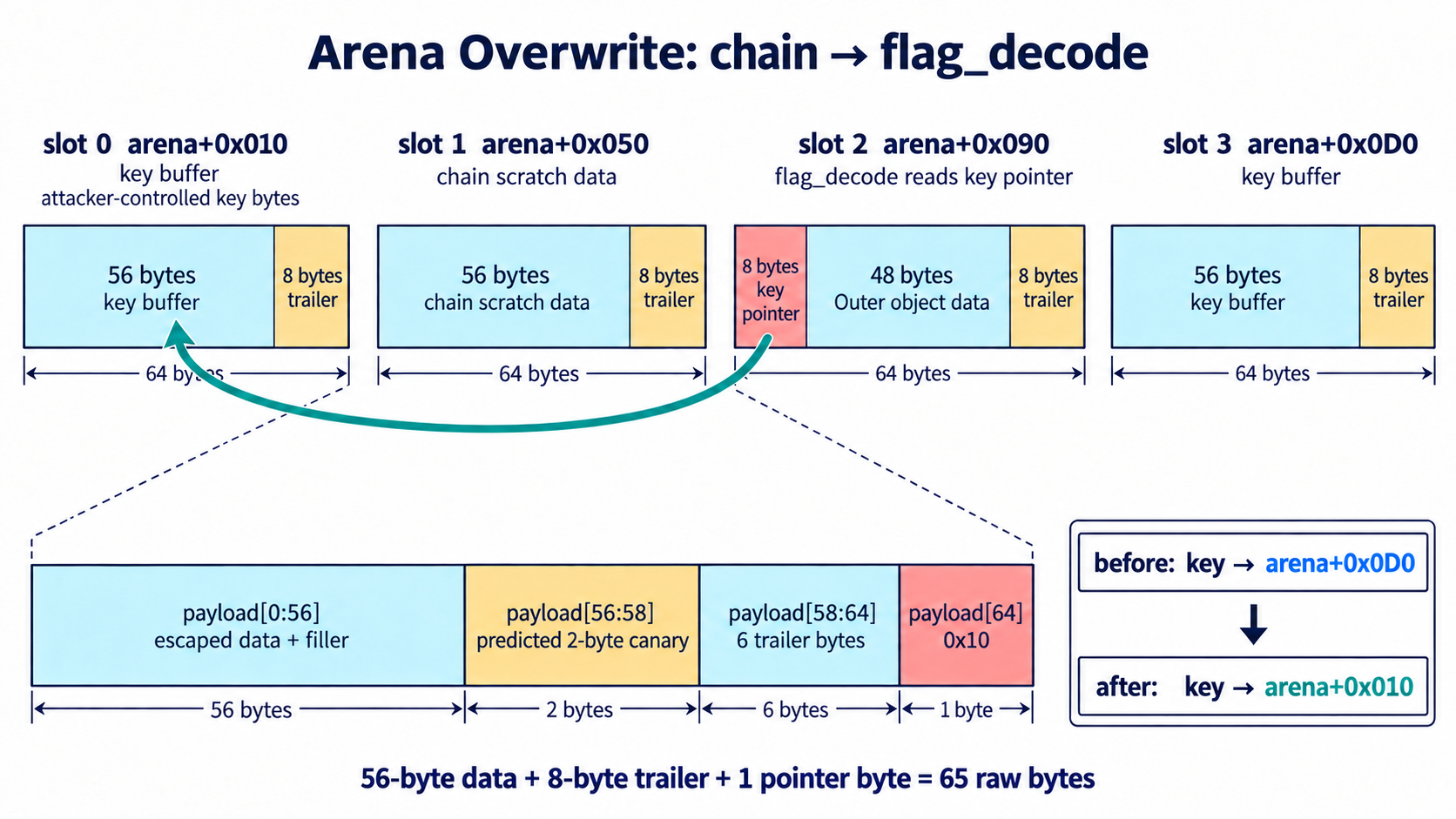
The 65th raw byte changes the low byte of Outer.key_pointer from 0xd0 (the key slot) to 0x10 (the catalog-session override). flag_decode follows that pointer and copies its argument there. Its normal 55-byte limit is stretched by loading the DLL under several aliases: the broker treats a non-breaking space as part of a raw name, while the catalog trims it. Independent DLL instances write consecutive 55-byte pieces at arena+0x010, +0x047, +0x07e, and +0x0b5, making a continuous value up to 220 bytes.
Ask the catalog the wrong question
The catalog concatenates the selected session into SQLite. The TCP parser splits at ordinary spaces, so the injected SQL uses tabs instead:
'\tUNION\tSELECT\tjson_group_array(json_array(key,hint,notes))
\tFROM\tdebug_info--
The result comes back where DLL bytes should be. Loading it fails, but the broker leaves the text file in the sandbox and file_download retrieves it. The useful row contains a deployment-specific dbg_... key and says to prepend :<key>: to the session UUID.
That prefix activates a hidden catalog debug worker. Text after the keyed UUID becomes a Jinja template with a dbg object. Its dbg.x method accepts Base64-encoded x86-64 bytes, allocates executable memory, runs them, and returns RAX.
Grow past the 128-byte limit
dbg.x accepts only 128 bytes per call, but Windows rounds its VirtualAlloc allocation to a page and the worker does not free it. Several short calls write 40-byte pieces into one persistent executable page. The staged 288-byte scanner uses VirtualQuery to skip unreadable regions, then searches committed readable memory for TISC{.
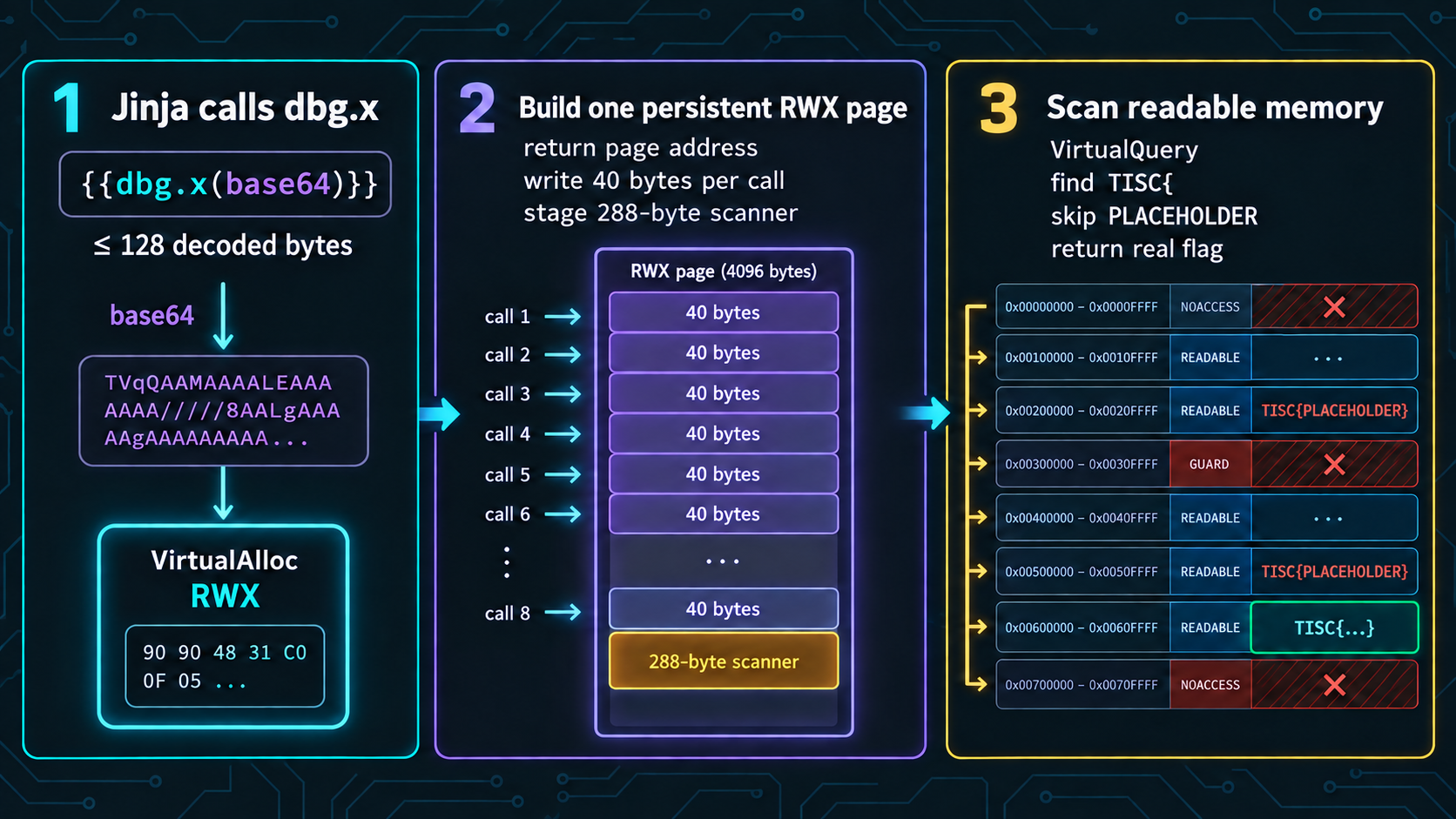
The returned address is read eight bytes at a time until }. The flag is:
TISC{h0pe_YoU_5tiLL_h@ve_t0k3ns_L3ft}
Reproduce it
From the solution/ directory, python3 solve.py runs the canary prediction, override, SQL query, debug-worker staging, and memory scan against the challenge endpoint. It imports the accompanying scripts and reads scan_flag_memory.bin; all are included in the downloads.
Resources & downloads
Selected files referenced by or useful for reproducing this solve.